
Hear strictly Haitian voices explore and explain some of the current nuances of Haiti's housing crisis, nearly 5 years after the earthquake:
Tarps, Tents
Tuesday, December 30, 2014
This 16-minute film, Tarps, Tents, Houses, Homes was produced by MCC Haiti earlier this year (2014), in partnership with the Haiti Housing Collective. The film explores the recent state of tent camps in Port-au-Prince, nearly five years after the earthquake. It also highlights some failed and successful housing programs for victims, and sketches a narrative that explains causes for the earthquake's devastation.
Hear strictly Haitian voices explore and explain some of the current nuances of Haiti's housing crisis, nearly 5 years after the earthquake:
Hear strictly Haitian voices explore and explain some of the current nuances of Haiti's housing crisis, nearly 5 years after the earthquake:


Tuesday, December 23, 2014
We have enjoyed following the Advent calendar this season, with the aid of readings and meditations from a guide given by a friend. Taking us through the troughs and peaks represented in the cycle of this holy season, this time has reminded of the darkness, yet the joy and anticipation inherent in the daily living of the Christian faith.

And here is a picture I took yesterday of the beach. Something about the beauty, constancy, and rhythm of the waves makes me think of the cycle of longing, anticipation, and joy we experience this season.

It starts with a recognition of the brokenness of this world, and the brokenness sometimes hidden in our lives. We realize that we need a Savior. We are then filled with joy in thinking of a future where every pain and heartache is extinguished, and a deep gladness and wonder as we think on God's promises embodied among us. Emmanuel. The baby Christ came to us in an utter miracle, born to humble hands to serve us all. The pages of Scripture are thick with this testimony.
In the backdrop of this particular Advent season, we have known of the protests playing out across the U.S. The streets of Port-au-Prince have also been protest-ridden. People are angry, crying out for something better than the current political gridlock and historic antipathy from those in power.
Will you join us in prayer this Christmas? Let us pray, in this season of Light and Hope, for God's peace to be evident, binding up the brokenhearted, turning hearts towards Him, and creating a way forward where there seems to be no way, a way that bears witness to His Kingdom and Truth. Amen.
I'm including here a picture of a Christmas tree we saw in Port-au-Prince this month; a symbol of the season.
And here is a picture I took yesterday of the beach. Something about the beauty, constancy, and rhythm of the waves makes me think of the cycle of longing, anticipation, and joy we experience this season.
Tuesday, December 16, 2014
A friend asked for some insights into 'daily living' here; habits or activities that may be unusual for us. After living here for 5 months now and 'going through some of the motions' for several weeks now, I admit I had to think on it for a second! (Or rather, a few weeks :) Some small things:
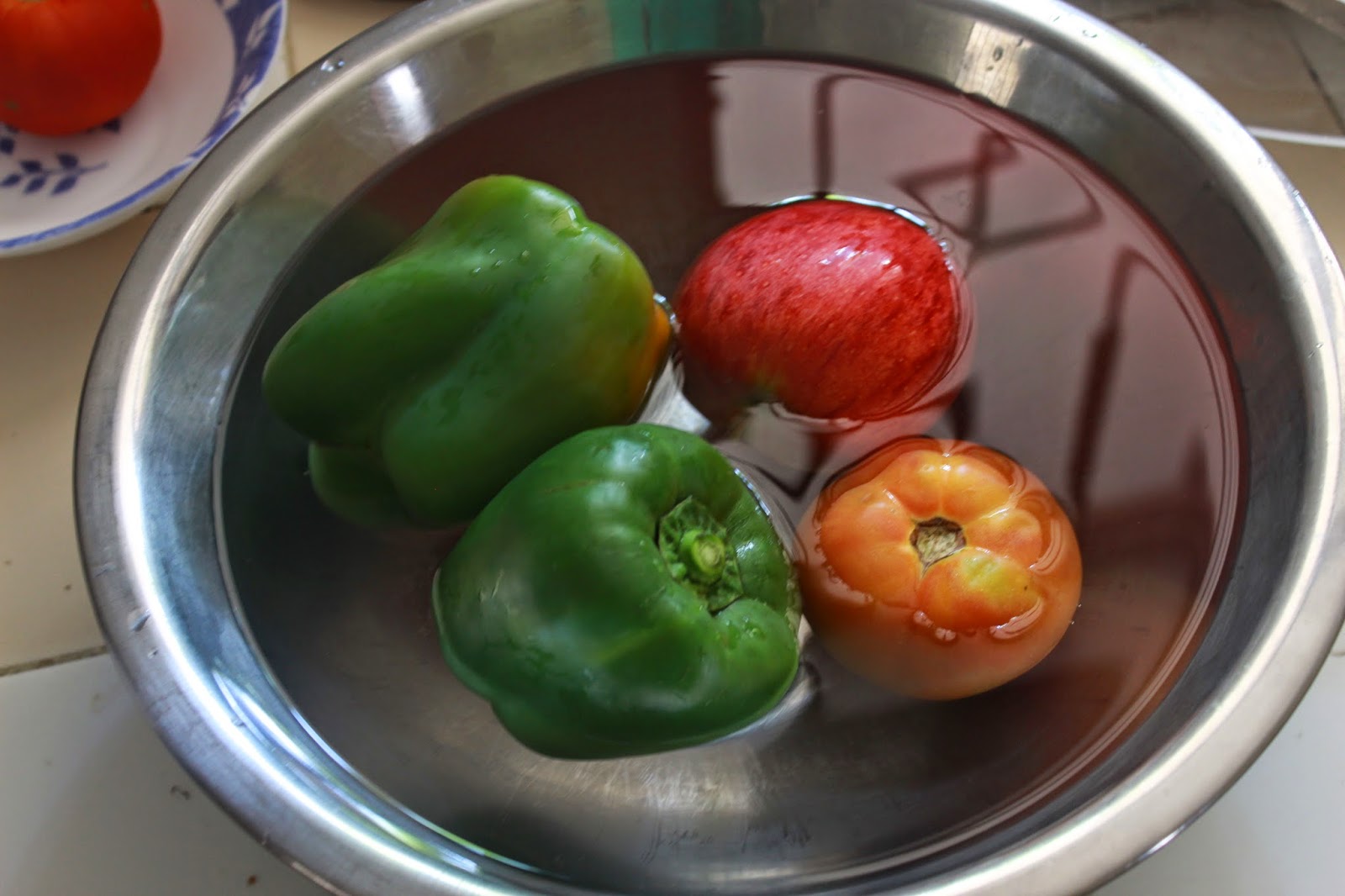
Veggie soak. Bleaching or soaking our veggies in vinegar water before eating them raw or cooking them. This isn't that bad, but just a regular precaution. It has taken some getting used to. And I admit I'm still not sure about what does and doesn't 'need' to be soaked.
On October 10, we actually had a dear friend come and visit us for one week. Ama grew up in West Africa, and she is accustomed to many of these food preparation practices. Her visit 1) got me digging into our Mennonite cookbooks more intentionally, to make sure we were providing some well-rounded meals while she was here! and 2) helped me gain confidence cooking with a lot of produce and also experimenting with new recipes, given the 'raw materials' on hand.
I would say that, overall, our seeming limitations when it comes to cooking (i.e. also not having different strengths on our oven burners - high heat, or, high heat!) have actually helped me to experiment and make some healthier, yummier meals overall (can't rely on those delicious premade sauces and other wonders at Trader Joe's or Aldi! )

Goats. What do you do when the weeds are taking over your yard? Why, borrow your boss's goats to eat the weeds, of course! But when one is pregnant and whiny the whole time, they don't focus as much on eating, and the progress may not be as impressive as you would have thought. It was worth a shot, though! And not uncommon practice in Haiti apparently. I like the idea -- a goat-borrowing system for all your pressing yard-care needs.


Yard burning. I am not accustomed to setting a fire in our yard multiple times per week, but it's what you gotta do here! Burning yard waste and kitchen waste is a regular necessity, because it's too much trouble to try fitting it all into our little trash bin I guess. The smell of smoke from neighbors' fires wafts into our room some nights. It's not too bad -- except when there's more than leaves and paper products being burned... yuck!

Veggie soak. Bleaching or soaking our veggies in vinegar water before eating them raw or cooking them. This isn't that bad, but just a regular precaution. It has taken some getting used to. And I admit I'm still not sure about what does and doesn't 'need' to be soaked.
On October 10, we actually had a dear friend come and visit us for one week. Ama grew up in West Africa, and she is accustomed to many of these food preparation practices. Her visit 1) got me digging into our Mennonite cookbooks more intentionally, to make sure we were providing some well-rounded meals while she was here! and 2) helped me gain confidence cooking with a lot of produce and also experimenting with new recipes, given the 'raw materials' on hand.
I would say that, overall, our seeming limitations when it comes to cooking (i.e. also not having different strengths on our oven burners - high heat, or, high heat!) have actually helped me to experiment and make some healthier, yummier meals overall (can't rely on those delicious premade sauces and other wonders at Trader Joe's or Aldi! )
 |
| Our friend Ama. I really like this picture, but you can actually see her face below. |
Yard burning. I am not accustomed to setting a fire in our yard multiple times per week, but it's what you gotta do here! Burning yard waste and kitchen waste is a regular necessity, because it's too much trouble to try fitting it all into our little trash bin I guess. The smell of smoke from neighbors' fires wafts into our room some nights. It's not too bad -- except when there's more than leaves and paper products being burned... yuck!
Saturday, November 15, 2014
 |
| Two tree nursery committee members planted a "small forest" project (behind) using the traditional konbit |
We just returned from our first Mennonite Central Committee
(MCC) konbit, a quarterly staff gathering. While there was no
back-breaking labor involved, there are more similarities between a traditional
konbit and MCC’s than you might think.
A coming-together. Beyond work in the fields, konbit has survived because it is a social scene: a chance to trade stories and gossip, complain and sing. Our konbit is a chance for MCC’s Port-au-Prince and Desarmes teams to reunite. Though we sometimes cross paths in the intervening months between konbit, this was a chance to really catch up: to meet new staff members; to see how a staff member’s baby has grown; and to deepen relationships.
Music. Drums, bamboo or conch-shell horns, flutes: the chef of the konbit in the fields often employs a band to play these instruments throughout the day. The music serves to set the work team’s tempo and keep up the party-like atmosphere. Our konbit started each morning with the sounding of the drum and Kreyòl worship songs that prepared our hearts and minds for the work ahead.
Food. Any good konbit starts and ends
with food. Maybe a cup of sweet coffee and bread to begin, and a stomach-bursting
meal at its end. The Desarmes team’s cook Lucilla made hearty meal after hearty
meal, providing the foundation for times that were fit to laugh and share and
enjoy one another’s company.
Respect and Mutuality. Both types of konbit grow from the recognition that we need each other. There’s a common Kreyol proverb that’s translated as “Many hands make the burden light,” and as I reflect on our first konbit experience, I’m reminded of a command in Galatians 6:2, “Bear one another’s burdens, and so fulfill the law of Christ.” In sharing the load, we are able to see our hearts resonate with Christ’s own love and concern for others, and we’re further knit together as a community.
The rum. Just kidding. While many traditional konbits do see the bottle passed around throughout the day and end in a big rum-drenched party, ours did not. We instead closed out ours with fritay--fried goat, pressed plantains, and pikliz--a crowd-pleasing combination of foods meant to mark a special occasion, of which it most definitely was.
 |
| Almost all of the MCC Haiti team at our MCC konbit |
Hard work. A konbit in the field
usually starts as the sun is rising and lasts until mid-day or early afternoon.
Our konbit is really a series of meetings where every member of our team
is able to speak his or her mind. Two of the three days involved eight hours of
meetings like this, all in Kreyòl. We agreed on an agenda together, reported on
our activities, and posed questions to puzzle through difficult issues.
A coming-together. Beyond work in the fields, konbit has survived because it is a social scene: a chance to trade stories and gossip, complain and sing. Our konbit is a chance for MCC’s Port-au-Prince and Desarmes teams to reunite. Though we sometimes cross paths in the intervening months between konbit, this was a chance to really catch up: to meet new staff members; to see how a staff member’s baby has grown; and to deepen relationships.
Music. Drums, bamboo or conch-shell horns, flutes: the chef of the konbit in the fields often employs a band to play these instruments throughout the day. The music serves to set the work team’s tempo and keep up the party-like atmosphere. Our konbit started each morning with the sounding of the drum and Kreyòl worship songs that prepared our hearts and minds for the work ahead.
* Listen to our team singing "Mesi Jezu" at Konbit
(just press play)
(just press play)
Respect and Mutuality. Both types of konbit grow from the recognition that we need each other. There’s a common Kreyol proverb that’s translated as “Many hands make the burden light,” and as I reflect on our first konbit experience, I’m reminded of a command in Galatians 6:2, “Bear one another’s burdens, and so fulfill the law of Christ.” In sharing the load, we are able to see our hearts resonate with Christ’s own love and concern for others, and we’re further knit together as a community.
The rum. Just kidding. While many traditional konbits do see the bottle passed around throughout the day and end in a big rum-drenched party, ours did not. We instead closed out ours with fritay--fried goat, pressed plantains, and pikliz--a crowd-pleasing combination of foods meant to mark a special occasion, of which it most definitely was.
Monday, October 27, 2014

Piti piti zwazo fe nich
It is a favorite Haitian proverb of ours, and it means "Little by little, the bird makes its nest." The meaning is pretty clear, and it applies to so many situations. My two friends and fellow graduate students at the time - Sarah and Gina - and I used this phrase a lot when we were here in late 2010. After reaching the point in an introductory conversation where our limited Kreyol ran out, we would smile and recite this phrase. It signified, for us, that our Kreyol was coming along, so to please be patient with us. People loved that we knew this phrase. It was a real crowd-pleaser.
For us today, it provides a reminder of a broader perspective. That we are like "little birds," just coming along in our understanding of so many things here. But, each step is productive towards some larger goal. Nothing is lost! Even those days when we feel like we don't quite pass muster, we can rest assured that even the bad bits can be used for something greater - redeemed for His higher plan.
Friday, October 10, 2014
It could be said that our blog posts up till now haven’t
been very informative but have given
you a glimpse of some fun pictures and stories from our near 11 weeks in
Haiti.
Now that it’s Friday evening and I’m sitting in our living
room while my poor husband lays sick in our bedroom (stomach bug perhaps?) I think
I will take this opportunity to share about some of the important events from
Haiti this week and our work. Within these updates, I think you will find some
specific ways you can be praying for us and for Haiti.
 |
| 'Baby Doc' Duvalier |
Last Saturday, Haiti’s infamous dictator from 1971 – 1986, “Baby
Doc” Duvalier died of a heart attack. He returned to Haiti in 2011 and almost immediately was charged with crimes against humanity, though he
has been allowed by current President Michel Martelly to “roam free” even with serious charges pending. Public anger here and abroad mounted as word leaked from the
National Palace that President Martelly was considering giving the ex-President
a national funeral. Baby Doc Duvalier is charged with having stolen hundreds of millions of dollars from the
State and having up to 30,000 of his opponents tortured and killed during his reign. How could the State consider
spending more funds to “honor his memory” in such a public way? The Palace decided
to not fund the funeral – which will take place tomorrow morning.
 |
| Ex-President Aristide |
Meanwhile, ex-President Aristide – who was the first
democratically elected President in Haiti in 1991 – has faced charges of
corruption and embezzlement of government funds during his Presidency. A couple of months ago, a judge with a questionable
record summoned Artistide to court. When he did not show up, the judge placed
him under house arrest. Two weeks later, the armed guards protecting Aristide’s
house were “secretly” ordered to move, thereby leaving Artiside’s home
unguarded. Outcry came from Haiti and the U.S., from big names such as actor
Danny Glover and Congresswoman Maxine Waters. Today, crowds gathered outside of
Aristide’s home again as the judge ordered Aristide’s immediate arrest.
Many people saw this as President Martelly’s attempt to “get
rid” of Aristide, and also to distract from the biggest political news in
Haiti, which has been the government’s failure to hold important elections for the past 4
years. A bipartisan group from the U.S. Congress has urged President Martelly
to ensure that elections are held before the end of this year, but this does
not seem likely to happen. Six opposition senators in Haiti are refusing to
vote for a new electoral law, which would allow elections to go forward. Many
people here feel that President Martelly is corrupt and has a vested interest
in not holding senatorial elections, which could allow him to consolidate power
in early January 2015 as the senate would be rendered ineffective.
 |
| MINUSTAH troops in Haiti |
In 2004, after President Aristide was ousted from power a
second time, the UN’s peacekeeping force established a mission in Haiti
(MINUSTAH), and they have been here ever since. There is much public discontent
over MINUSTAH’s presence. Their mission is costly (it is about to be renewed for $500
million for another year), and there has not been a recognized conflict in Haiti
for the past 75 years. In addition, MINUSTAH’s troops, over the years, have
faced hundreds of allegations of sexual abuse and exploitation. There is no
formal complaint mechanism established for victims to file claims. Most
drastically, MINUSTAH’s Nepalese troops were responsible for introducing
cholera to Haiti in 2010; the epidemic has killed over 8,500 Haitians since,
and the UN will not claim responsibility.
 |
| Photo credit: theguardian.com |
MINUSTAH’s mandate is up for renewal again this coming October 15th.
On top of this, October 19th is the 4 year
anniversary of Haiti’s cholera outbreak. The outbreak started when sewage leaked
from the UN Nepalese soldier’s base camp into Haiti’s main river and water
source – the Artibonite. Various scientific reports have concluded that
MINUSTAH’s base camp was the source of the epidemic.
On October 23rd, a court in NY will hear oral
arguments concerning the UN's "immunity." This is one success in a long-standing effort by human rights groups to hold the UN accountable and seek reparations for families who lost loved ones due to the cholera outbreak.
 |
| Photo credit: theguardian.com |
All this to say, people are sad and tensions are
running high. It’s easy to feel the outrage in the public discourse, both here
and in the U.S. Yesterday, the UN held a donor conference in Washington DC, to
plead for funding for their 2.2 billion dollar Cholera Eradication and Sanitation plan for Haiti.
The results of the conference were not promising. Only ten percent of their plan has been funded to date. Many people balk at the large sums being spent to keep MINUSTAH in Haiti, while funds are lacking to actually improve health and sanitation systems in the country.
As you can see, there is a lot going on this week. And this doesn't touch even touch on other issues we are engaged in such as: mining in the north of Haiti, and Haiti's housing crisis, around which we are working on planning a conference in Washington DC.
It would mean a lot to us if you took note, and took the time to pray over some of these areas, as well as our presence and work here.
(I am happy to report, that by the end of my writing this blog post, Ted is feeling much better.)
Tuesday, October 7, 2014
Ok folks. This is something great about sponsoring a child or investing in a child's life in one way or another. Here is my latest note from Purity, a child that my friend and I started sponsoring back in 2004, and who Ted and I now continue to support. Precious! She lives in Kenya. I highlighted the parts that especially jumped out and grabbed my heart. So thankful for the known and unknown impacts of this relationship over the years.
Hello! How is you, your family and your beloved husband, Ted? For me I am fine and my family as well. I am doing my very best at school now that I've got a few months to go. Very soon I'll be sitting for my Kenya Certificate of Secondary Education and I'll request you to pray for me.
As you know I am now turning seventeen years on 15th of this month which will be my birthday and this shows how far I am going and much bigger am getting. Thank you for the support that you've always given to me and my family and I promise to put a smile on your face and show you how great and thankful I am to you in my final examination in my high school education. May God bless you and your family abundantly. Greet Ted for me and always know that we love you all. Please let me know if there is anything you'll want me to pray about. I will always pray for you.
Hello! How is you, your family and your beloved husband, Ted? For me I am fine and my family as well. I am doing my very best at school now that I've got a few months to go. Very soon I'll be sitting for my Kenya Certificate of Secondary Education and I'll request you to pray for me.
When I finish my high school education I want to keep my self busy by enrolling in computer lessons and after that in God's will go to the University that I've been wanting to go. There I will study my future career as an accountant. I am always grateful for all you have been doing for me, even the communication we've been having has really encouraged me a lot.
As you know I am now turning seventeen years on 15th of this month which will be my birthday and this shows how far I am going and much bigger am getting. Thank you for the support that you've always given to me and my family and I promise to put a smile on your face and show you how great and thankful I am to you in my final examination in my high school education. May God bless you and your family abundantly. Greet Ted for me and always know that we love you all. Please let me know if there is anything you'll want me to pray about. I will always pray for you.
Subscribe to:
Posts (Atom)

